
Academy
Education and clinical upskilling for the future of dentistry
Digital dentistry has changed what practices need from their support teams, and training needs to keep pace. The Academy exists to close that gap and, just as importantly, to give people a way to prove they have closed it.
Our course material is delivered through training providers under their own academic standard. We contribute the framework, the assessment and evidence tools, and the practice network that turns classroom learning into demonstrated capability.
The flagship pathway
Future DA Framework™
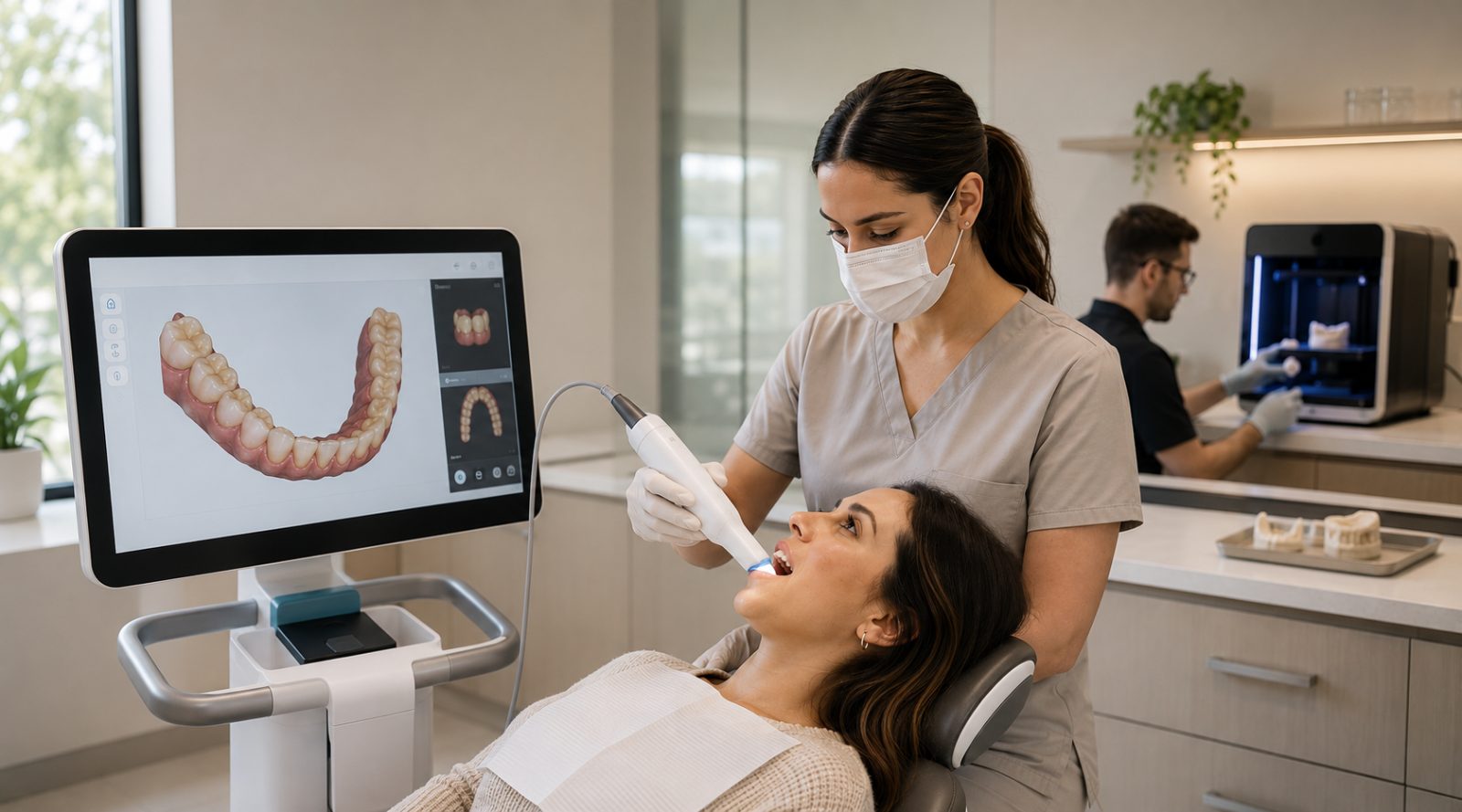
An 8 week online program, with 38 hours of combined practical and clinical experience, for dental assistants moving into digital dentistry. It covers clinical readiness, intraoral scanning, clinical photography and chair-to-lab handover, then puts all of it to work in a supervised placement in a real practice.
The structure is deliberate. Theory alone can produce people who can describe a scan but freeze when a patient is in the chair. Placement alone can produce people who copy whatever habits the practice already has, good or bad. Doing both, in that order, is designed to produce someone who understands why the workflow exists and can hold the standard when it is busy.
Graduates finish with proof of what they can do, not just a certificate.
The curriculum
Six modules, 8 weeks, 38 practical hours
What the program actually covers.
01 — Infection control and room setup
Setting up and turning over a surgery properly, infection control standards, and the habits that keep a clinical day running without compromise.
02 — Chairside support
Anticipating the clinician, instrument handling, four-handed technique and the practical rhythm of assisting through a procedure.
03 — Intraoral scanning
Core scan competence that is not tied to a single brand of scanner: capture technique, managing difficult cases, recognising a poor scan before it leaves the room, and knowing how to fix it.
04 — Record quality
Clinical photography and records that support treatment planning and case communication, with the consistency a laboratory and a clinician can rely on.
05 — Chair-to-lab handover
What gets sent, in what form, with what information attached.
06 — Patient communication
Explaining what is happening, managing anxiety at the chair, and the everyday communication that decides whether a patient comes back.
Who it suits
Built for three kinds of people
New entrants
People starting out who want to enter dentistry with skills practices are actively short of, rather than competing for entry-level roles on availability alone.
Working dental assistants
Staff already in a practice who can assist confidently but have never been properly taught to scan, and want to move up rather than sideways.
Technicians and support staff
Anyone who handles scans, records or chair-to-lab handover and wants to do it with more confidence and fewer reworks.
Delivery
How the program is actually run
We do not issue qualifications. Training providers deliver our material under their own accreditation and quality system, and we agree scope, branding, data use and approvals in writing before anything runs.
- Framework. We supply the course structure, content, assessment tools and evidence templates.
- Delivery. The training provider runs the program under its own academic standard, with its own trainers and its own quality assurance.
- Placement. We open our practice network so learners complete a supervised placement in a working clinic rather than a simulated one.
- Evidence. Learners finish with a documented record of what they performed, supervised and signed off, that an employer can actually read.
That split keeps the academic responsibility where it belongs and the industry connection where we can genuinely add it.
Outcomes
What graduates leave with
Beyond the certificate.
Demonstrated scan competence
Core scanning capability on whatever system a practice runs, evidenced in a real clinical setting rather than claimed on a resume.
A workplace evidence record
A documented portfolio of supervised work that answers the question every employer asks: what can this person actually do on day one?
A route into employment
Graduates are known to our Talent division, which places permanent, locum and specialist staff into practices across Australia.
Talk to us about the Academy
If you are a training provider, we will set out what a partnership involves and what each side contributes.
If you are a professional, tell us where you are now and what you want to be doing, and we will tell you honestly what the pathway looks like from there.